Disguised Alpha   /   Compound references. Original research.
KLOW StackResearch reference

GHK-Cu + BPC-157 + TB-500 + KPV

KLOW StackFour components. Clear context.

KLOW brings four catalog-listed components into one formulation. Their individual literature spans connective-tissue biology, cell movement, copper-peptide chemistry and inflammatory signaling. This guide explains what researchers actually tested and where the evidence stops. A collection of interesting component findings does not establish a validated four-component blend.

Component evidence; exact blend unvalidated

A focused reference from the Disguised Alpha research network.

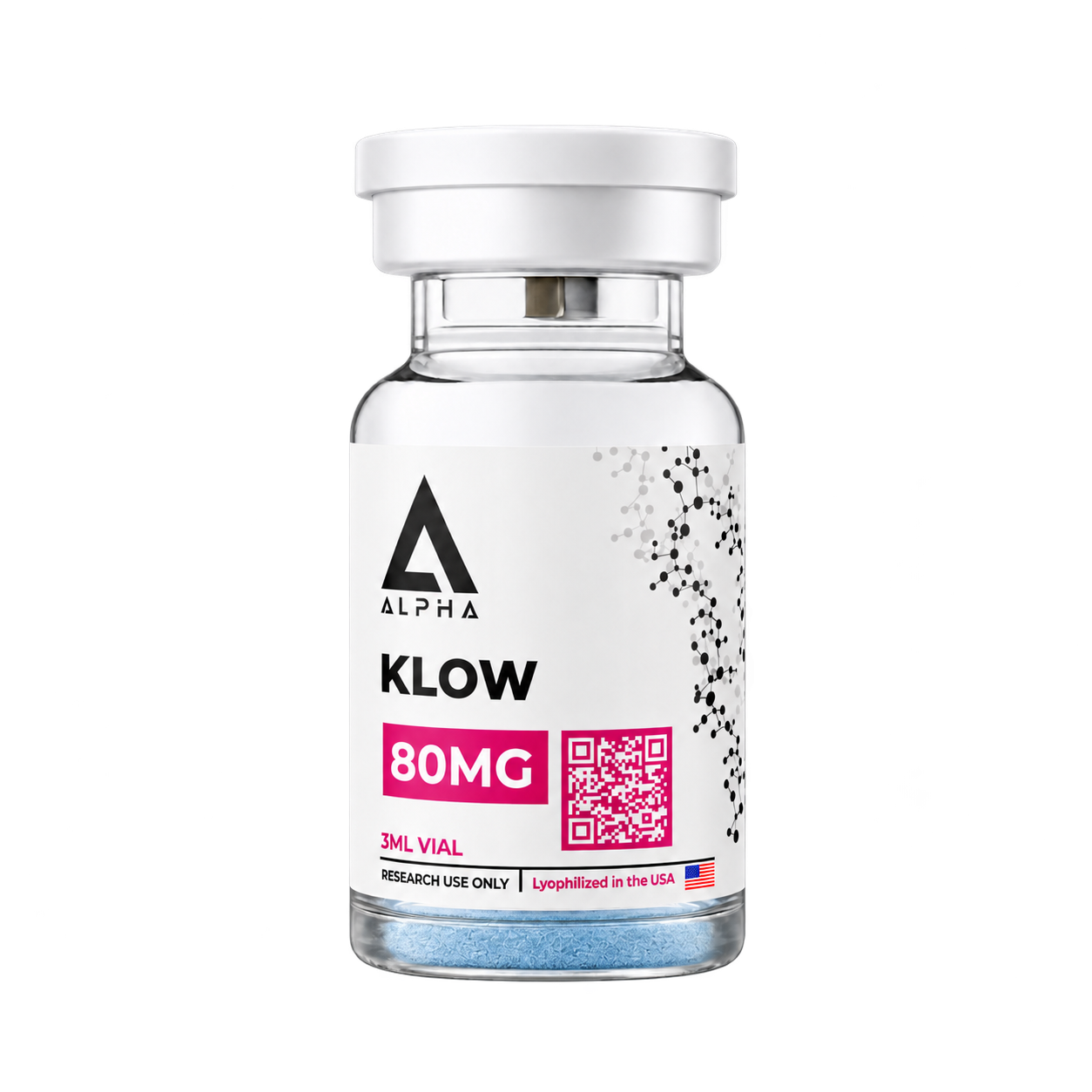
Disguised Alpha KLOW Stack product reference image
KLOW StackCatalog imagery · RUO
Formulation
KLOW Stack
Components
4 named components
Evidence scope
Individual components

Disguised Alpha catalog

Find the matching product.

Open the exact product listing for its format and documentation. Published studies do not validate a supplier’s finished product.

01 / The science

Meet the components.

Each component has its own identity and literature. Read those findings separately from claims about the finished blend.

01

GHK-Cu

Glycyl-L-histidyl-L-lysine coordinated with copper(II). Researchers study its effects on collagen production in fibroblast cultures. Copper binding is part of the material's identity, so free GHK and GHK-Cu should not be treated as interchangeable labels.

Read the primary source ↗
02

BPC-157

A synthetic 15-residue peptide. Experiments investigate tendon-cell signaling, including growth-hormone receptor expression. Observed changes in a cellular pathway are mechanistic findings, not confirmation of a clinical benefit.

Read the primary source ↗
03

TB-500

A label associated with an acetylated thymosin beta-4 fragment in analytical research. Confirm the actual sequence before applying fragment or full-length thymosin beta-4 findings to a material.

Read the primary source ↗
04

KPV

The tripeptide lysine–proline–valine. Its literature includes peptide-transporter uptake and inflammatory-signaling experiments in cell lines and mouse models. These studies investigate KPV as an individual component, rather than KLOW.

Read the primary source ↗

02 / Read with context

Know what the evidence can tell you.

None of the four cited component studies tested the finished KLOW formulation. They do not establish synergy, mixture stability, delivery performance or safety of the combined product. Formulation-specific evidence is needed before making conclusions about the mixture itself.

Start with three questions.
01What was tested?
Check the exact molecule, sequence, composition and formulation.
02Where was it tested?
Cells, animals and clinical populations answer different questions.
03What was measured?
A pathway signal is different from a demonstrated clinical outcome.

03 / Selected publications

Go straight to the source.

Original records, study models and the limits that matter when interpreting a result.

STUDY 01
Fibroblast cell culture

GHK-Cu and collagen production

The copper-peptide complex increased collagen synthesis in the experimental system. The observed effect was independent of an increase in cell number, distinguishing matrix production from simple cell proliferation.

Reading limit: A cell-culture endpoint cannot establish skin or connective-tissue outcomes for people using a mixed formulation.

↗
STUDY 02
Cultured rat Achilles-tendon fibroblasts

BPC-157 and receptor signaling

Investigators found increased growth-hormone receptor expression after BPC-157 exposure. Adding growth hormone affected proliferation measures and downstream JAK2 signaling in the prepared cells.

Reading limit: This was a laboratory mechanism study, not evidence that KLOW changes hormone levels or improves recovery in humans.

↗
STUDY 03
Mass spectrometry and synthetic reference material

TB-500 identity before interpretation

Researchers chemically identified Ac-LKKTETQ in the sample, providing a reference for interpreting its molecular identity.

Reading limit: This identity study did not evaluate KLOW or establish the composition of a current batch.

↗
STUDY 04
Human cell lines and two mouse colitis models

KPV uptake and inflammatory signaling

KPV uptake involved the PepT1 transporter. Researchers observed lower inflammatory signaling and cytokine measures in the experimental systems, alongside changes in mouse colitis outcomes.

Reading limit: Human-derived cells are not human clinical trials. Neither these findings nor the mouse results validate KLOW for gastrointestinal disease.

↗

A focused selection, not a systematic review. Studies concern the tested material and do not validate a supplier’s finished product.

Explore research & source notes →

04 / Common questions

A little more clarity.

Quick answers for reading the science behind KLOW Stack.

Is KLOW a single peptide?

No. It is a formulation name covering four components. The blend name does not replace their individual chemical identities or the need to document actual composition.

Do the studies prove that all four work better together?

No. Separate component findings cannot demonstrate additive or synergistic effects. That question needs a study of the exact mixture with appropriate component controls.

Do results transfer between catalog formats?

Not automatically. A vial, capsule and transdermal formulation can differ in composition and delivery. Evidence must match the tested material and formulation.

Where can I keep reading?

The full profile in the Disguised Peptides research hub adds further compound context. Disguised Alpha publishes this guide and is linked throughout the site.

Continue your research

One compound. A wider research library.

Explore the complete KLOW Stack profile and related compounds in the Disguised Peptides research hub.

Open the full profile ↗